

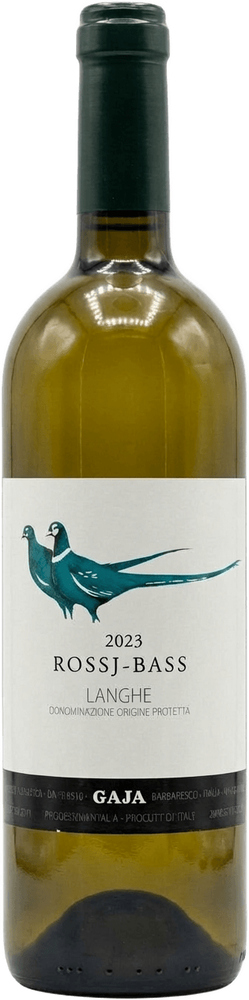
Rossj-Bass (2023)
SommeliAI Insights
Gaja Rossj Bass 2023 is a Langhe Bianco built on Chardonnay with a small touch of Sauvignon Blanc, showing citrus, white flowers, peach, and a clean mineral finish.
About this wine
Rossj Bass 2023 is a Langhe DOC white from Gaja made predominantly from Chardonnay with a small portion of Sauvignon Blanc, commonly listed around 95 percent Chardonnay and 5 percent Sauvignon Blanc. It opens with bright citrus and orchard fruit, plus white floral notes like acacia and wisteria, then moves toward peach and a light saline, mineral edge. The texture is medium to full, with fresh acidity that keeps the wine focused as the fruit turns more toward grapefruit, lemon, and ripe stone fruit. Winemaking is typically stainless steel fermentation for about four weeks, followed by aging in oak barriques for roughly six to seven months, with malolactic fermentation completed during élevage, which helps explain the wine’s rounder mid palate. The fruit sources come from multiple estate sites in the Langhe, including the Rossj and Bass vineyards planted in 1984, and the wine’s first vintage was 1988. Overall it drinks like a structured, modern Piemonte white, balancing ripe fruit and subtle oak spice with lift and a long, tidy finish.
About the grape
Chardonnay, originally from Burgundy, became a key international variety in Piedmont when Angelo Gaja began planting it, and the Rossj parcel for this wine was planted in 1984 and named for his daughter Rossana. In Rossj Bass, Chardonnay is the backbone of the blend, usually about 95 percent, chosen because it keeps its structure and fruit clarity even when part of the lot is fermented or aged in oak for a short period. Sauvignon Blanc, best known from the Loire and Bordeaux, was also introduced to the Gaja estates in the early 1980s, and here it is used in a small share, often about 5 percent, to add lift and aromatic definition without changing the wine into a varietal Sauvignon. The name Bass refers to a lower lying site, and the Chardonnay and Sauvignon Blanc lots are assembled from estate vineyards across the Langhe to balance ripeness with freshness in a consistent house style.
Quick facts
- 👨👧 The name is a two part family and landscape tribute, “Rossj” is Angelo Gaja’s daughter Rossana’s nickname, and “Bass” refers to a vineyard in the lower part of the hill (basso meaning low).
- 🌱 Both of the “name vineyards” (Rossj and Bass) were planted in 1984, relatively modern by Piedmont standards, which helped define Gaja’s signature white style in the Langhe.
- 🎬 Rossj-Bass debuted with its first vintage in 1998, making it a comparatively young classic in Gaja’s lineup.
- 🦚 The label’s pheasants are not decorative whimsy, they nod to the pheasants that live in the woods bordering Gaja’s vineyards.
- 🗺️ It’s a white blend built from multiple Langhe sites, including vineyards around Treiso and Chardonnay fruit from Serralunga d’Alba, connecting Barbaresco country with a Barolo commune in one bottle.
Palate profile
Producer
Gaja, established in 1859 by Giovanni Gaja in Barbaresco, Italy, has been a pioneering force in winemaking for over 160 years. The Gaja family, originally from Spain, settled in Piedmont in the 17th century and began producing wines that would later gain international acclaim. Angelo Gaja, the founder's great-grandson, revolutionized Italian viticulture by introducing practices such as single-vineyard bottlings, the use of barriques, and the cultivation of international grape varieties like Cabernet Sauvignon and Chardonnay. Under his leadership, Gaja expanded beyond Piedmont, acquiring estates in Tuscany's Montalcino and Bolgheri regions, further solidifying its reputation for excellence. Today, the winery remains family-owned, with Angelo's children continuing the legacy of innovation and quality.
