

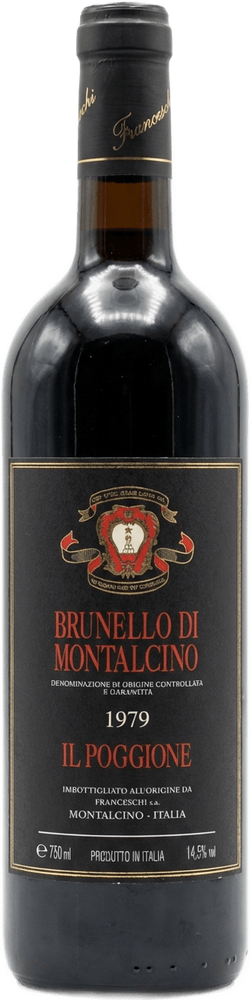
Brunello di Montalcino (1979)
SommeliAI Insights
A mature Brunello from Tenuta Il Poggione showing evolved Sangiovese character with dried cherry, leather, and gentle spice notes.
About this wine
This wine is made from 100 percent Sangiovese, the traditional grape of Brunello di Montalcino, and was produced by Tenuta Il Poggione, a historic estate in Sant Angelo in Colle. In Il Poggione cellar practice the winery ferments on a submerged cap and historically ages Brunello in large oak followed by long bottle maturation, with more recent Brunellos often aged in French oak barrels. After more than four decades in bottle this 1979 displays tertiary aromas of dried cherry, leather, tobacco, and earth, with hints of cedar and baking spice. The palate is likely to be mellowed and rounded, showing soft but still present tannins, a drying mineral thread, and concentrated savory fruit where the original freshness has evolved into more dried and savory tones. Aged Brunello from this era can retain a vibrant structure while developing complex tertiary layers, reflecting the region's long aging potential. Contemporary accounts of early eighties Il Poggione bottles note persistent tannic grip and flavors of prune, cocoa, and balsamic notes, which help explain the savory and slightly leathery profile a 1979 bottle would show today. The wine was sourced from vineyards planted at elevations between 150 and 450 metres above sea level and was harvested by hand, details that contribute to its ripe but balanced character.
About the grape
Brunello di Montalcino has long been made exclusively from local Sangiovese, in Montalcino often the thicker skinned Sangiovese Grosso type that was selected and propagated in the late 19th and early 20th centuries for its concentration and aging potential. Tenuta Il Poggione has relied on old estate plantings and selected Sangiovese biotypes, including vines in the Vigna Paganelli planted in 1964, and the estate still uses these clonal selections when they replant to preserve local typicity. In the vineyard Sangiovese at Il Poggione is trained with cordon spur and the local doppio capovolto method across elevations from about 150 to 450 metres, which gives growers options to pick for balance across a range of seasons. In the cellar Il Poggione has traditionally fermented with indigenous yeasts and aged Brunello in large oak casks, practices aimed at expressing the structure and longevity that Sangiovese provides in this bottling.
Quick facts
- 🏛️ Il Poggione is one of the very early Brunello houses, the estate was already marketing Brunello as early as the 1900s so a 1979 bottle comes from a house with over a century of Brunello history
- 🕰️ The 1979 vintage in Montalcino is remembered as a classic year with warm summer ripening that gave Brunellos the structure to age for decades, so a 1979 Brunello often shows complex tertiary notes today
- 🌾 Il Poggione sits on a huge 530 hectare farm with only a portion planted to vines, which means your 1979 bottle was made on an estate that mixed viticulture with olive groves, grain fields and livestock
- 🌱 Vineyards like Vigna Paganelli were planted in the 1960s and supply old Sangiovese biotypes, so a 1979 Il Poggione Brunello likely carries fruit from vines whose clones later influenced other Tuscan vineyards
- 🧭 Bottles from the late 1970s from top Montalcino producers often develop pronounced aromas of leather, tobacco, dried fig and forest floor, so a 1979 Il Poggione can be a mini time capsule of aged Sangiovese character
Palate profile
Producer
Tenuta Il Poggione, established in the late 19th century by Florentine landowner Lavinio Franceschi, began after he was captivated by the Montalcino region's beauty and community. The estate was among the first to market Brunello di Montalcino in the early 1900s and played a pivotal role as a founding member of the Brunello di Montalcino Consortium. Spanning approximately 530 hectares, it includes 140 hectares of vineyards and 50 hectares of olive groves, with the remainder dedicated to other agricultural uses. The winery emphasizes sustainable practices, such as installing solar panels and maintaining manual vineyard work, to ensure high-quality wine production.
